
Quantum Information Science
WHY THIS MATTERS
Quantum Information Science (QIS) is a rapidly evolving field that harnesses the power of Quantum Mechanics and Information Theory to study the processing, analysis and transmission of information.
2025 is designated as the International Year of Quantum Science and Technology by the UN. This highlights the immense importance of the field, which will lead to increased public awareness, investment, and collaboration worldwide. While there are many use cases and applications around QIS, the first step to practical use cases will be around full-scale, fault-tolerant Quantum Computers. This year Quantum Technology is moving beyond pure theoretical exploration towards experimental demonstrations.
Quantum Computing has demonstrated its potential to disrupt the classical computing & communication landscape. The frequency and sophistication of cyberattacks are constantly increasing. The classical communication relies on computational assumptions for security, which are potentially vulnerable to advanced algorithms and future quantum computers. The primary motivation for quantum communication stems from the fundamental need for enhanced security against the growing concerns and looming threat of Quantum Computers on classical secured communication. The current encryptions those are potentially vulnerable to advanced algorithms that Quantum Computers can offer leveraging the principles of quantum mechanics and have the theoretical capability to break same at an exponentially faster rate. This poses a significant threat to the security of sensitive data across various sectors and critical infrastructure. Quantum communication aims to achieve information-theoretic security, where security is guaranteed by the fundamental laws of physics (principles of quantum mechanics) rather than computational complexities.
CORE CONCEPTS
Quantum Information Science is based on below fundamental core concepts of Quantum Mechanics, which differentiate it from Classical Information Science significantly.
QUBIT (Quantum Bits): A Qubit is the fundamental unit of quantum information, analogous to a classical bit in traditional computing, but with quantum properties.
Quantum Entanglement: The quantum phenomenon where two or more quantum particles become intrinsically linked in such a way that the quantum state of each particle cannot be described independently of the other, even if they are separated by a vast distance(spooky action at a distance – Einstein). Alternatively, it is described as the individual states of Quantum particles such as electrons, photons and atoms etc. are indeterminate until a measurement is made, but once one is measured, the state of the others is instantaneously determined, irrespective of the physical distance.
Superpositions: The ability of a Quantum system or Qubit to exist in multiple states at once until it is measured, which forms the basis for Quantum parallelism, where a quantum computer can effectively perform calculations on many inputs at once.
No cloning theorem and Wave function Collapse: The No-Cloning Theorem is a fundamental principle in quantum mechanics that states it is impossible to create an identical and independent copy of an arbitrary unknown quantum state. Quantum states can exist in superpositions, and copying them would require knowing their exact amplitudes, which can’t be determined without disturbing the Quantum state. The wave function describes the complete quantum state of a system. When measured, the wave function collapses, the wave function collapses to one of the possible outcomes converting the system from a superposition state to a quantum state.
Before measurement:- ∣ψ⟩=α∣0⟩+β∣1⟩ After Measurement:- ∣ψ⟩=∣0⟩
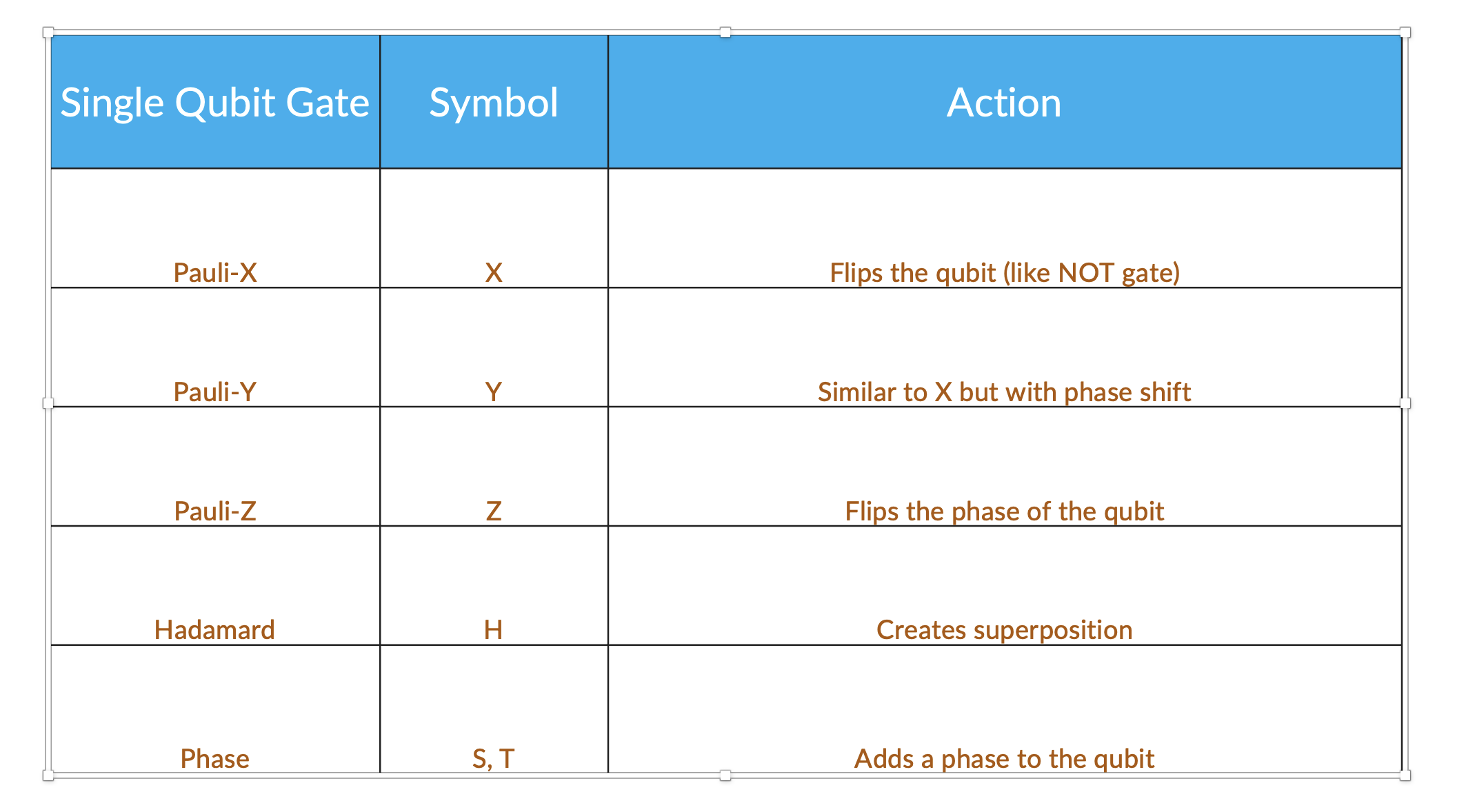
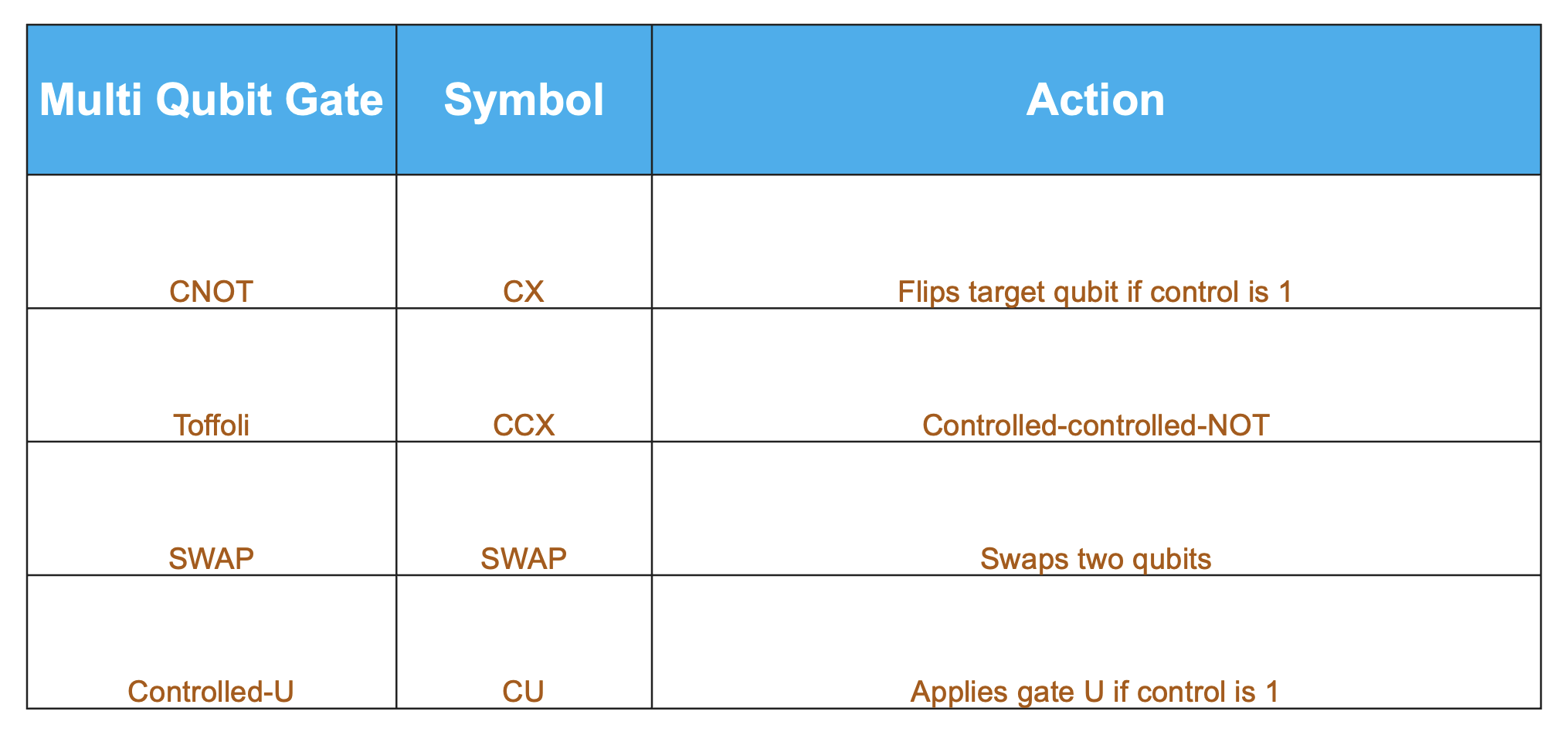
Quantum gates and circuits: A quantum gate is a fundamental operation that transforms the state of one or more qubits. The Classical logic gates operate on bits (0 or 1), whereas the quantum gates operate on qubits that can be in superpositions of 0 and 1, and can also be entangled state. The Quantum gates are also called as quantum logic gates or unitary operators. The Quantum gates are single-qubit gates or multi-qubit gates. They are reversible and preserve the total probability. Some of the common single or multi qubit gates are as below:-
Quantum measurement: Quantum measurement is the process of observing a quantum system, which causes its wave function to collapse into a definite state. It contrasts with the classical measurement, wherein the measurement observes a pre-existing property. Quantum measurement involves the quantum system interacting with a macroscopic, classical measurement device that causes the quantum state or wave function to collapse. Once the wave function collapses, the information about the original superposition is fundamentally lost and the process can not be reversed to retrieve the original superposed state.
Decoherence: Quantum decoherence is the process by which a quantum system loses its quantum behaviour, such as superposition or entanglement, due to interaction with its environment. It can happen to a photon carrying quantum information through a fibre optic cable or to an entangled pair of qubits that might lose their correlation due to noise in the environment. In the context of quantum communication, decoherence is a major challenge because it can destroy the quantum information being transmitted. Quantum error correction and Quantum Repeaters are helpful to mitigate decoherence to certain extent.
APPLICATIONS
The major application areas for QIS are still in the research and development stage. The various impactful applications are as listed below:-
- Quantum Computation
- Cryptography
- Optimization
- Molecular Simulation
- Quantum Communication
- Quantum Key Distribution (QKD)
- Quantum Teleportation
- Quantum Internet
- Quantum Sensing and Metrology
- High Precision Measurement
- Navigation and Positioning
- Quantum and AI/ML
- Accelerate training through Quantum Algorithm
- Pattern Recognition
In the next posts, we will explore more about the applications, compare them with classical applications wrt its strengths, limitations, and suitable problem domains.
Please share your thoughts below in the comments section. Thanks for reading!!

Ananth CB
A very good introduction to Quantum Information Science ! Looking forward to detailed examples of its applications and comparison with classical methods.
swetaganguly
Thank you!