
Encoding classical information into Qubits
In the last blog post, we touched the the concepts of bases and correlation in the context of QKD and kept it for a detailed explanation this week. Even before understanding bases and correlation, let’s take a step back and understand why these are discussed in the context of Quantum technology. Ever wondered how classical information represented as text, numbers, and images is converted into Quantum bits? Let’s understand.
The Digital Whisper: How Our World Becomes 0s and 1s
Digitisation offered elegant solutions to Analogue’s Problems and created an era of unprecedented control, accessibility, and innovation through :-
- Perfect Preservation and Durability
- Efficient Storage and Instant Retrieval
- Unprecedented Manipulability and Sharing
- Automation and Computation
In a digital system, all information ultimately boils down to binary code, or sequences of 0s and 1s. The 0s represent Off, Low, False or No and 1s represent On, High, True or Yes here. All numbers, text (ASCII or UNICODE), images (through pixels), Audio (through a process called sampling and quantisation), Video (a sequence of still images or frames displayed rapidly, combined with synchronised audio) are converted into a sequence of bits.
How Information Flows (from Classical to Quantum and Back)
The most important point to note here is: images, text, and photos are not directly “converted” into qubits in the same way they are converted into classical bits; rather, Classical Digitisation is done 1st if information is not already digital. Later, the classical bits are converted to Qubits using one of the strategies, depending on the applications. Some of the well-known strategies are 1> Direct Encoding 2> Amplitude Encoding 3> Angle Encoding 4> Basis and Superposition Encoding in QKD which we will be discussing in detail here.
The complete cycle of information flows are as below:-
1> Classical Input to Quantum Information: Classical information after digitisation is converted into bits, which are later converted into the initial quantum states of qubits through a process called “state preparation.”
2> Quantum Processing: The qubits then undergo a sequence of quantum gate operations, using superposition and entanglement concepts to perform the computation or communication tasks. During this phase, the information remains in its quantum form.
3> Quantum Information to Classical Output: The final stage post post-quantum processing, is when the qubits are measured. Due to the collapse upon measurement, the probabilistic outcomes are converted back into classical bits (0s and 1s), which can then be read and interpreted by a classical computer.
This conversion process, leveraging the unique properties of Quantum Mechanics, is what gives Quantum Technologies their potential for unprecedented computational power and fundamentally secure communication.
Why is analogue information not converted into Qubits rather than digitised to 0 and 1 first is an interesting question that can be asked and will be covered in the next post 🙂
How bases and correlation map to the classical bits ‘0’ and ‘1’ in Quantum Key Distribution (QKD)?
Considering BB84 protocol as an example here
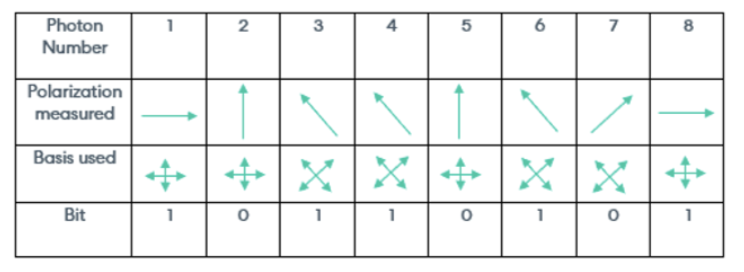
BB84 protocol uses two mutually unbiased bases.
1> Rectilinear Basis (or Standard Basis): a> Vertical Polarisation (↕): This is typically mapped to the classical bit 1. b> Horizontal Polarization (↔): This is typically mapped to the classical bit 0.
2> Diagonal Basis (or Hadamard Basis): a> Diagonal Polarisation (↗): This is typically mapped to the classical bit 0. b> Anti-Diagonal Polarisation (↘): This is typically mapped to the classical bit 1.
The Journey of a single photon
The sender (S) chooses a bit (0 or 1), chooses a basis, Rectilinear or Diagonal and sends the information over the Quantum channel. The receiver (R), upon receiving the photon, chooses a random basis to measure. If the bases are coincidentally the same, then the actual bit can be retrieved; otherwise, the disturbance or noise comes in.
After Sender (S) sends all her photons and Receiver (R) measures them, they communicate over an authenticated classical channel about which bases they used for each photon. If their bases match for a given photon, their measurement results should be correlated; they should both have the same 0 or 1. For the photons, if their bases do not match, the measurement result gets discarded. The remaining bits form the sifted key as discussed in the previous post.
The simple depiction of bases and correlation to bits for a series of photons can be understood from below table.
Detecting Errors and the presence of an Eavesdropper
After sifting, Sender and Receiver have a shared raw key composed of bits where their bases match a subset of which they share publicly, expecting a perfect correlation in the absence of an Eavesdropper(E). If E is present, and makes her measurements in the wrong basis (50% probability), the photon state is disturbed. When this disturbed photon then reaches R, even if a correct basis is chosen , the state has been altered, leading to a higher probability of measuring a different bit than S originally sent. This is how errors are introduced and s significant number of these errors (a high Quantum Bit Error Rate – QBER) indicates a lack of perfect correlation, signalling presence of an Eavesdropper.
This interplay of choosing bases randomly and then verifying through correlations is what makes QKD a powerful and secure method for distributing cryptographic keys.