From Waves to Qubits: Bridging the Quantum Divide
In a world increasingly shaped by quantum technologies, one question often puzzles even seasoned technologists: Why can’t analogue information be directly converted into qubits? At first glance, it seems intuitive—after all, quantum systems are inherently physical and continuous. But the reality is more nuanced.
Analogue information isn’t converted directly into qubits because the fundamental nature of quantum computing algorithms is Digital. While a qubit itself can hold a continuous, analogue-like superposition of states, the way we program and control quantum computers is through a series of discrete, step-by-step operations called Quantum Gates.
The Digital Framework of Quantum Algorithms
Quantum computers, in their most common form, operate similarly to classical digital computers but with quantum-specific rules.
Quantum Gates: Quantum algorithms, much like their classical counterparts, are constructed from a sequence of logical operations. These operations are executed by quantum gates, which are discrete, well-defined transformations applied to qubits. To perform arithmetic, implement logic, or execute tasks like quantum search, a quantum computer must apply these gates in a precise and ordered sequence. The design and arrangement of these gates form the Quantum circuit, which determines the behaviour and outcome of the algorithm. This gate-based model is central to digital quantum computing and underpins its programmability and versatility.
Measurements: At the end of a quantum computation, the qubits are measured. This measurement forces the qubit’s superposition state to collapse into a definite binary state of either 0 or 1.
Error Correction: One of the biggest challenges in quantum computing is noise and decoherence, which can corrupt the delicate quantum state of a qubit. Digital encoding allows for the development of quantum error correction codes. These codes are specifically designed to detect and correct errors in discrete qubit states, a task that would be incredibly difficult with continuous, analogue-encoded information.
The process of converting analogue information (like a sound wave or a sensor reading) into a binary format (0s and 1s) using a classical computer’s Analogue-to-Digital Converter (ADC) is a necessary first step. Once this information is in a digital format, it can be easily encoded into the discrete states of qubits, making it compatible with the gate-based model of quantum computing.Trying to directly represent an infinite-precision analogue value in qubits would be both impossible and incompatible with the logic gates and measurement processes that make quantum computers useful.
Beyond the Gates: The Analogue Computing Alternative
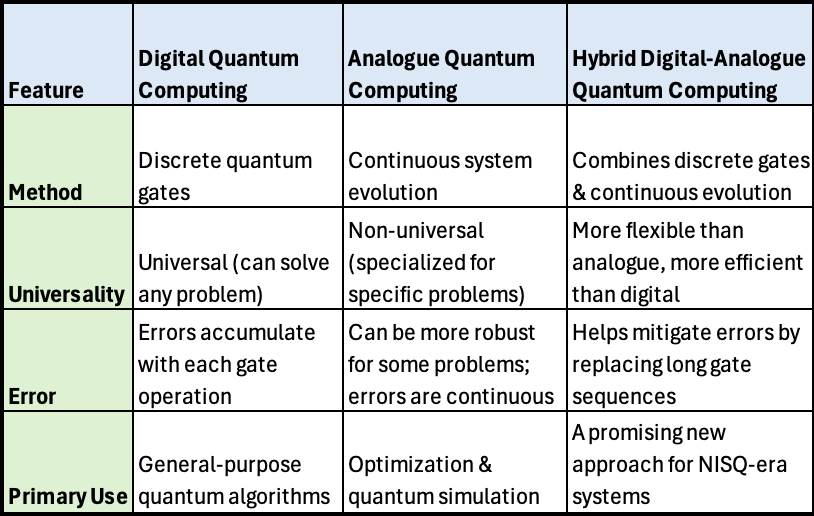
However, there is a separate field of research called analogue quantum computing that doesn’t use discrete gates but instead lets a physical quantum system evolve naturally to solve a problem. It’s often used for specialised tasks like quantum simulation, where the quantum computer is engineered to directly mimic another physical system. However, this method is less flexible and versatile than the universal, digital-gate-based approach.
Quantum Annealing is a specialised form of analogue quantum computing designed to tackle complex optimisation problems. The process begins with the system in a low-energy superposition of all possible solutions. As it gradually evolves, the system “anneals” toward its lowest energy state, ideally corresponding to the optimal solution. Instead of using quantum gates like digital quantum computers, quantum annealing relies on the natural behaviour of quantum systems to find these answers. Quantum Annealing leverages the natural dynamics of quantum systems to efficiently explore large solution spaces, making it particularly effective for problems in logistics, scheduling, and machine learning.
The Rise of Hybrid Approaches
While digital quantum computing is more versatile and universal, its biggest challenge is error correction. Analogue systems, in some cases, can be more robust against certain types of noise. This has led to the development of digital-analogue hybrid Quantum computing, which combines the strengths of both approaches.
Digital-analogue hybrid quantum computing combines the precision and flexibility of digital quantum gates with the efficiency and speed of analogue quantum evolution to create more robust and powerful systems. It’s a key strategy for making the most of today’s noisy quantum computers, which are limited in their ability to perform long, complex sequences of digital operations without errors.
Digital-analogue hybrid quantum computing combines the precision and flexibility of digital quantum gates with the efficiency and speed of analogue quantum evolution to create more robust and powerful systems. It’s a key strategy for making the most of today’s noisy quantum computers, which are limited in their ability to perform long, complex sequences of digital operations without errors.
How it works?
Digital Block: The process often begins with digital gates to prepare the qubits in a specific initial state. These gates are precise, programmable operations that allow for a wide range of starting configurations and are essential for encoding the problem’s data.
Analogue Block: Once the qubits are prepared, the system is switched to analogue mode. Here, the qubits are allowed to evolve continuously under a controlled physical process, governed by a Hamiltonian. This natural evolution is much faster and less prone to certain types of errors than a long sequence of individual digital gates. It’s especially useful for solving problems like quantum simulations or complex optimisation, where the problem’s dynamics can be directly mapped to the system’s natural evolution.
Back to Digital: After the analogue evolution period, the system can be switched back to digital mode to perform final measurements or further manipulations. This allows for precise analysis of the results. The digital part also acts as the control system, fine-tuning the parameters of the analogue evolution and ensuring the entire process is coherent and controlled.
This is a promising new approach that combines the best of both worlds. It aims to use the speed of analogue systems with the precision and control of digital systems.
The future of quantum computing may not be a single winner, but a diverse ecosystem where each approach is used for the tasks it performs best.